
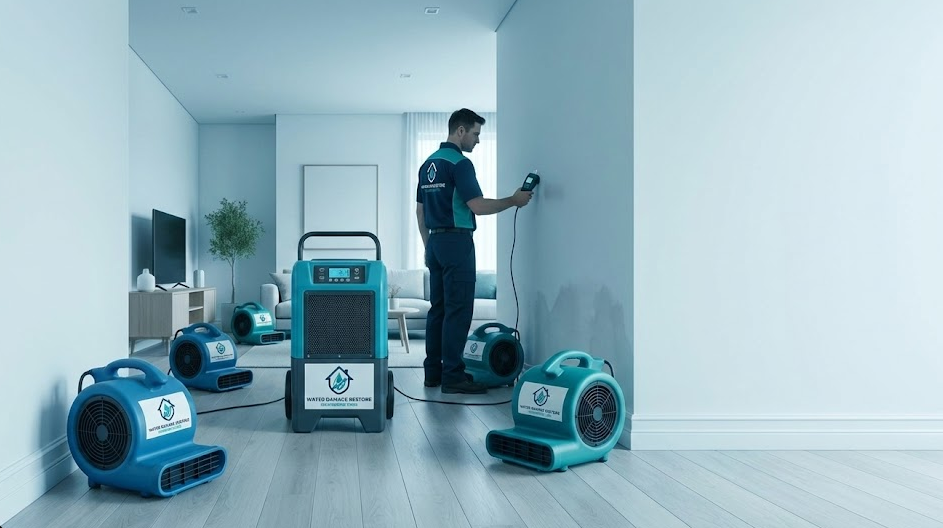
A failed supply line is the most common water loss we attend in Rosenberg, and it is the one where what the homeowner does on day one matters most. Water does not sit still. It follows the path of least resistance, wicks up drywall, runs under cabinets and settles into the slab and subfloor.
Shut the water off first
Find the main shutoff and close it. In most Rosenberg homes it is at the street side of the property near the meter, or on the exterior wall nearest the water heater. If the leak is clearly at one fixture, the local stop valve under the sink or behind the toilet is faster. Then open the lowest tap in the house so the water still in the lines drains there rather than into a wall cavity.
Cut power to the affected rooms
If water has reached outlets or baseboards, switch those circuits off at the breaker before you walk through it. Never step into standing water and reach for a light switch.
Photograph before you touch anything
This is the step people skip and later regret. Wide shots of each room, then close-ups of the failure point, the water line on the wall, and any damaged contents. Insurers pay on documented loss, and once you have lifted carpet and moved furniture the evidence of how far the water travelled has gone.
Get the standing water out
Standing water is the part you can tackle yourself, with a wet vacuum, towels and a squeegee. What that cannot do is pull moisture back out of the structure, which is what emergency water removal and metered structural drying and dehumidification are for. Do not use a household vacuum, and do not assume that a floor which looks dry means the assembly beneath it is.
Move air, but do not improvise
Open interior doors and cabinet toe-kicks so trapped air can exchange, and run the air conditioning, which dehumidifies as it cools. Household fans help surface evaporation but cannot dry a wall cavity. In Gulf Coast humidity, pushing damp air around without dehumidification can move moisture into dry parts of the house rather than remove it.
Why 24 to 48 hours is the number that matters
Mould establishes on damp organic material within roughly 24 to 48 hours, and the humidity here keeps us at the short end of that range. A clean-water loss dried promptly is a drying job. The same loss found four days later is a drying job plus emergency mould remediation, containment, and usually drywall replacement, at several times the cost.
We respond across Herff Farms, Longwood, Willow Park and the rest of Rosenberg at any hour.
Do not demolish before the assessment
Owners often pull baseboards and cut drywall before anyone has looked at the loss. Sometimes that is right. Often it removes material that would have dried in place and turns a repairable wall into a rebuild. Get the assessment first; it costs nothing.
Frequently Asked Questions
Should I run fans before help arrives?
Yes for surface air movement, and run the AC to bring humidity down. But fans alone cannot dry a wall cavity, and without dehumidification you can spread moisture rather than remove it.
Will insurance cover a burst pipe?
Sudden accidental discharge from a failed supply line, water heater or appliance hose is normally covered. Slow seepage the insurer treats as a maintenance issue often is not.