
The figure quoted everywhere is 24 to 48 hours. It is broadly right, and in a humid subtropical climate like ours we are almost always at the fast end of it.
What mould needs
Spores are already present in every building. They need moisture, an organic food source and time. Drywall paper, timber framing, carpet backing, insulation and household dust all qualify. Temperature matters too, and the range mould prefers is simply the temperature of a Rosenberg house.
Why humidity shortens the window
Drying depends on the difference between the moisture held in a material and the capacity of the surrounding air to accept it. When ambient relative humidity sits at 80 or 90 per cent, as it does here for much of the year, the air has very little capacity left and evaporation slows sharply. A wall that would give up its moisture in two days in a dry climate can stay wet for a week here, and every one of those days is a day the colony is establishing.
That is precisely why dehumidification rather than air movement alone carries the work. Air movers without dehumidifiers, in this climate, largely relocate moisture rather than remove it.
A realistic timeline
- Hours 0 to 24. Nothing visible. Moisture is migrating into the structure. This is the window where drying alone resolves the loss.
- Hours 24 to 48. Germination begins on the wettest organic surfaces. Usually still invisible; a musty smell often arrives first.
- Days 3 to 7. Visible colonies on drywall paper, carpet backing and the underside of flooring. Containment becomes necessary, because disturbing growth makes it airborne.
- Week 2 onward. Established growth inside wall cavities. Material removal is generally unavoidable.
Where it shows first
Rarely in the open. Look at the bottom 300mm of drywall, under carpet and pad, inside base cabinets and vanities, behind baseboards, and around air conditioning ducts and returns where condensation adds to the problem. A room can look and feel dry while the cavity behind the wall is not.
Smell is a real diagnostic
That earthy, musty odour is microbial volatile organic compounds, and it frequently precedes anything visible. If a room smells like that after a water event, treat it as a finding rather than a nuisance. Masking the smell without addressing the moisture removes your warning signal.
When drying is no longer enough
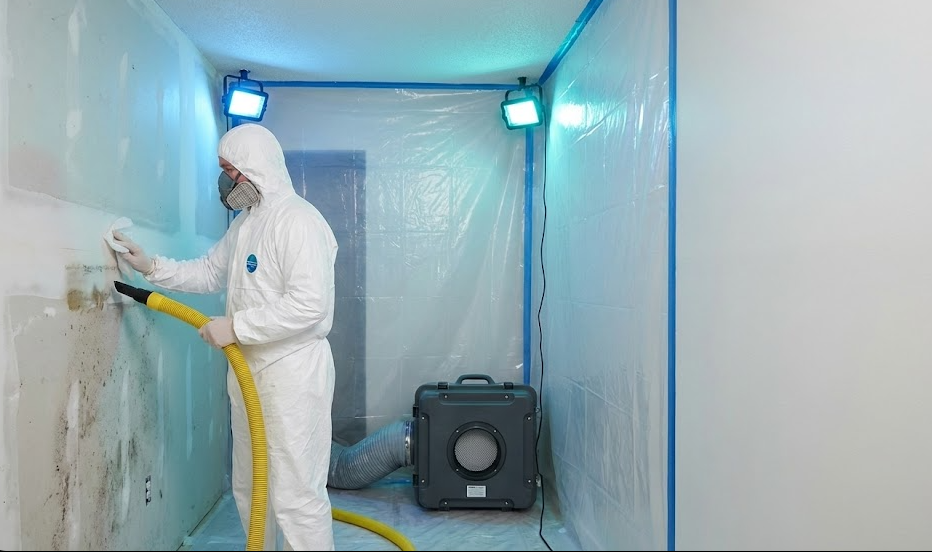
Once growth is established the job changes shape. Containment barriers and negative air prevent cross-contamination, affected porous material is removed rather than dried, remaining surfaces are treated with antimicrobial, and the space is verified before any rebuild. That is emergency mould remediation, and it is a materially larger scope than structural drying and dehumidification.
The whole argument for calling early is that it is the difference between the two. We work across Bending Oaks, Pecan Grove, Willow Park and the rest of the Rosenberg area.
Frequently Asked Questions
Can I just use bleach?
Bleach is largely ineffective on porous material. It removes the surface colour while leaving the root structure in the material, and the water it carries can feed further growth. It also does nothing about the moisture source.
Does mould always mean removing drywall?
No. Surface growth on non-porous material can often be cleaned and treated. Growth in the paper facing of drywall or inside insulation generally means removal.